



Leaderboard
-
bjcolglazier
Members12Points906Posts -
IndyGuy4KI
Admin6Points10,619Posts -
FUN&ONLY!
Members5Points1,967Posts -
Jr for Birdy
Members5Points2,551Posts



Popular Content
Showing content with the highest reputation on 05/02/2020 in all areas
-
5 pointsThe chart below shows the "normal" flu season in the US for the 2019-2020 season. Does the shape of the curve look familiar? It should, because it's nearly identical to the general shape of the US coronavirus curve as it stands right now. There have been a number of epidemiologists that have been predicting that this would be the case since the outbreak started. The chart starts at the end of September and runs through today. Notice the steady buildup of cases early, exponential increases leading to a peak, and then a really quick drop off: The point is that the coronavirus is following nearly the exact same pattern. About the only thing we haven't seen is the back side of the curve, the quick drop off. The virus has spread to nearly every country in the world despite measures to try and contain it. There are some things humans just don't have control over. My main concern in all of this is how the media has portrayed this situation. The overwhelming majority of news stories have been geared to do one thing and one thing only - to keep our eyes plastered on their programs via internet and TV. And it's working. Media viewership and ratings are way up right now (source: Variety). Stories about COVID patients recovering, beaches reopening and updates on states that have eased restrictions have been shoved aside in favor of stories that will keep people viewing, which generally speaking means you'll get items with a negative flavor. Things returning to normal is really the last thing the media wants. Those people who are living "normal" lives right now aren't being reckless - they've evaluated the information available and decided to take a calculated risk. If you're under age 60 and are not in a high-risk health category, then every study we've seen has indicated that group's risk associated with the virus is low. The vast majority of people who do contract the virus are asymptomatic. The most conservative estimates indicate that no fewer than 5 times as many people in the population have had or do have the virus than the actual numbers bear out right now. Some studies have that number at 20 or even 50 times higher. The overwhelming majority of people who contract the virus and do show symptoms have mild cases and recover. Mortality rates are much lower than originally projected. Health care systems didn't crash. Many people right now are fearful because they've been told that they need to be afraid. Some people have evaluated the available information and decided there's very little to justify that fear.5 points
-
5 pointsCheers to 2021, cause we ain't riding this year without a miracle. I'm invested and I pray I'm wrong but doesn't look good at all. I haven't yet read any back post cause I just got on but no way they can afford to open without very highly odds they'll have to close up from a large Covid outbreak. Suks, but I'm giving you the truth. Love Kings Island but if we have to wait an extra summer, stay safe.5 points
-
4 points
-
4 pointsIf you're worried about getting Covid-19 at Kings Island...don't go to Kings Island. Do you also have to make my decisions about going to Kings Island for me?4 points
-
3 pointsI have had countless hours at Vortex and WindSeeker where I get into the groove and have fun. Before I know it, I get rotated out and the first thing I say is "Wow, this hour went by way too quickly!" The beautiful part about working rides at Kings Island is the variety. You have different styles of rides with different height requirements and different positions. If you're operating your favorite ride, that is a special bonus. Working Vortex had its stressful moments as well as fun, but its being my favorite ride added a strong passion that shone through to fellow associates and guests. One of my favorite spiels was always "Thank you for riding my favorite ride, and enjoy the rest of your day here at Kings Island!" My passion for Vortex also spread to other rides. Any other ride I have worked or even rode only once always yielded an increased appreciation for that particular ride for what it was. I definitely did not appreciate WindSeeker, Bat, Express, Invertigo, Firehawk, or even the Carousel as much when I first started. This is very much why I'm always so happy when I work, at least as a ride op! But I must say I was always the happiest at Vortex.3 points
-
3 pointsThere is no way to guarantee that ever. Secondly, anyone at this point who walks into the park is taking a risk of possible exposure. Either you take the risk or you don't. To me it is no different than the warning signs before you get into the ride queue, but now that sign resides at your front door as you walk out.3 points
-
2 pointsThere's a legitimate problem with how the Covid-19 death count is being taken as well. There are all sorts of problems honestly. So many problems that it is really hard to determine media coverage from fact. It's 2020, you'd think we'd be way over that, but no. Everyone can find a headline to support their viewpoint. We've learned a lot March 1 to May 1. I anticipate we will also learn a lot from May 1 to July 1.2 points
-
2 pointsAnd not only do people in NYC live on top of each other, they are more reliant on public transportation and ride in crowded subways. Here, we all mostly drive our own vehicles.2 points
-
2 points
-
2 pointsCrazy that was 17 years ago. Back then would you ever think we'd have 3 B&Ms, and a GCI?2 points
-
2 pointsOr flew out or tossed from the ride.. CF is self insured so they determine the liability policy and risk...2 points
-
2 pointsHow about they just go around to each row and tell riders to buckle and lower restraints, then ask them to try to push up on the restraints after they are secured? They will have seen you do it, so they know it's done right. There's really no need to have them touch it or get close to you. The ride system should prevent dispatch if a restraint is not locked (at least that's how I think it works).2 points
-
2 pointsDeWine still thinks he can enforce a 14-day-quarantine on outside visitors. He's been progressive, if that's a good thing, but it's ridiculously un-enforceable. I anticipate him following Indiana's lead. Nobody wants what Michigan got...I'll just leave that there.2 points
-
2 pointsThese are my predictions for what Cedar Fair will implement across its parks once they reopen (these predictions are also heavily influenced by Six Flags’ confirmed measures): - Sanitation of benches, railings, tables, trains, etc. frequently throughout the day (they could possibly have park sweepers go around with disinfectant instead during their regular shifts) - At all food and merchandise locations there will be plexiglass partitions between the employees checking out and customers (Cedar Fair has already purchased these) - Rides will be limited in capacity, making sure guests have enough space between other riders (6 feet minimum) - Lines painted in queue lines to ensure social distancing and the introduction of some virtual queue lines (likely for Orion and other popular rides) - Park capacity will be reduced significantly below 50% - This last one is speculation, but I think all employees will be required to wear face make, and guests will be either required to or STRONGLY recommended to wear face masks For the last one (I know it is highly controversial and all guests may not want to comply) here is why: - Cedar Fair will want to protect its employees as much as possible and make guests feel as safe as possible around employees - How are employees supposed to check restraints standing 6 feet apart... they just can’t (while masks don’t replace social distancing, they will certainly help, but I still don’t know how the park is going to handle checking restraints) - It will look bad if people get Coronavirus at the park and the news blames the park for not doing more to protect its visitors (like requiring masks) - Cedar Fair has already purchased large orders of masks for use in its parks (they did this to USE them in their parks) - Last but not least, masks really do help somewhat to prevent the spread of Coronavirus, so why not? Cedar Fair can require guests to wear masks, and if guests do not comply, they have the right to kick them out. I could see Cedar Fair parks providing guests with free masks like Whole Foods is doing. In my honest opinion, I think Cedar Fair will strongly recommend masks to guests and provide them with optional masks (guests will not have to wear masks if they chose not to), but I still think employees will be required to wear masks. I think this policy on face masks will satisfy the most guests.2 points
-
2 pointsI'm often curious of the compulsion some people have to always be right about everything, to not sit back and think to oneself "hey I don't always need to chime in and feel like what I'm saying is right." I suggest a solution to this compulsion: sit back, take a breath, and tell yourself "I don't always need to feel like I'm right. I don't have to always chime in. Maybe people don't agree with me for a reason." Its not hard to do, heck I do it myself from time to time and I feel like its made me a better person.2 points
-
2 pointsI am not sure your exceptions are going to be met on what the parks are going to do. Companies and parks can only do so much to help reduce any possible spread. They can't control what germs walk into the gates. Everyone is taking a risk by walking in their doors.2 points
-
1 pointI could see Busch Gardens Tampa get one for the Sea World chain. Since they just got Iron Gwazi I wouldn't expect it for awhile but since they lack a traditional hyper in the park, or anything with good floater air. I think it would round out there line up well too.1 point
-
Regarding the media. This is how I try to approach it: The sources cited. Where does this information come from? Who is being quoted? What is their expertise? Does it give me enough information to make up my own mind? Look out for those who deem themselves the source of the information. The language being used. Are they using phrases like "might," "may," could," "seems like," etc. A lot of times the speculative nature isn't addressed directly, but instead implied through language. It's not just the media, you can see this a lot in this thread. I'm guilty of it myself sometimes. Something "seems to be true" or "is probably true," that means it is true, right? Wrong. The website or channel itself. Is it a major newspaper/news site/network, a website akin to Buzzfeed-ish/We Got This Covered, some sort of "(insert political affiliation) Daily" Facebook page, or is it just some dude on YouTube shouting in his truck? I'm not saying the media is perfect, but the other three are far more untrustworthy as they rarely cite sources nor approach the information presented with critical thought, and prey upon your angers, fears, and doubts regarding the media (or other entities). If someone is ranting and raving like some angry lunatic, I immediately click away. I had a speech teacher in film school who hammered this all this into us. I'll never forget what he told us on the first day: "You are not a source for information." He then would ding us for us for making bold claims, implied statistics ("most people this, most people that"), stating something as a fact without either citing a source or at least explaining what it is that makes us an expert on the subject (ex. "I worked in this field for 5 years").1 point
-
1 point
-
It could also be the larger cities got the resources to test earlier than other areas and rolled out testing to asymptotic people sooner. Our county only has around 50k, still requires hospital admission to test due to availability. 163 confirmed cases, 1 death out of 654 tests performed.1 point
-
The numbers are nowhere close to accurate. There's probably lots more undocumented cases. People who weren't able to get tested and those who just waited it out and got better on their own. I was reading on one page where someone got an antibody test to confirm if they had it and they did, back in NOVEMBER. So this virus has been here alot longer than we thought. It didn't just appear here at the end of February and beginning of March when we started testing. The scene in NYC (and everywhere else) would've been alot better if we were able to test sooner. It was very late when we started shutting everything down and testing. Earlier shutdowns and testing would've been far more effective.1 point
-
I've noticed this virus is impacting compact big cities really hard. It's hard to ignore. Besides climate, NYC and LA are completely different as far as how they live. LA is a sprawling city/area stretched out over miles and miles and miles. NYC is compact, with people living on top of each other by the thousands. See also Chicago and Detroit where people live on top of each other where the virus has hit really hard, versus places like St. Louis, or Dallas, or...Cincinnati.1 point
-
This. The numbers to watch are the percentage of positive cases of all tested, along with hospital/ventilator capacity. Those are the numbers that are important at this stage in the game.1 point
-
1 pointThis was the year I worked at Kings Island I will give you a guess what my home ride was. Sent from my iPhone using Tapatalk1 point
-
1 point
-
The picture, yes, but the tweet he sent out this week is not because he lost a bet! PS: it is actually the phrase for his new team LOL...but buckeye nation sees it differently Since you want every post here covid related LOL, here you go: Tom Brady was busted for working out in a closed park. Park was closed due to covid. Tom Brady walked into the wrong house. I am sure someone could say that is a violation of the covid order somewhere. I doubt the order is you cannot visit friends, but accidentally walking into someone else's home by mistake is an ok thing to do If the NFL doesn't play this season, you can thank Tom for that LOL, Let's blame him if Disney doesn't open as well while we are at it since his missteps took place in Florida LOL Either that Michigan education isn't all it is cracked up to be or he has had one to many concussions1 point
-
Michigan football is like Indiana basketball. A dead, has-been program.1 point
-
One thing I haven't seen discussed is the role of liability in when the parks open. I'm sure the lawyers will have a say in when and how they will open, and liability for any deaths from COVID-19 will be a major concern. While there's never a good time for a lawsuit, the park really doesn't need a lawsuit right now because someone got COVID-19 at the park and later died. This is one reason why a lot of businesses that could reopen are deciding to hold off. Of course they can't be sued just because someone got the virus in the park, they have to show the park was negligent in some way. This could be not training employees in proper procedures, not providing masks, gloves, sanitizer, etc. or not enforcing policies with patrons. I expect that whatever the policies are when the park reopens, they will be enforced. This is why safety rules are enforced much more than line jumping or smoking now. This could be one more factor in the financial equation of whether to open this year. Add this to a shortened season, reduced capacity, and extra cost of PPE, and they might decide to wait until next year.1 point
-
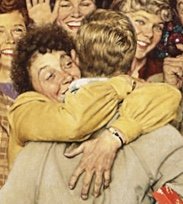
I like how you painted the healthcare system...It sounded so quaint, like a mother just waiting to help her boy out! (Oh if could only be like that...instead, it’s more like Mr. Burns is running it.)
 1 point
 -
1 pointIt's a lot more fun. You get a lot more personal interaction with guests. The crew tends to get fairly tight knit as there is a lot of trust built over time with learning the processes for the ride. Every single cycle has its own feel and time tends to go by fairly quickly, especially if you're out on the flight line. On a personal note I absolutely never liked working coasters, I always found them way too repetitive, but that's just me.1 point
-
Personally don't feel the CF would do away with restraint checks simply due to the liability it opens them up to. Every ride has someone who has never been on it before and may not know the proper secure position. And sensors can fail, IMO they should not by solely relied on to ensure safety. Just think of FoF and how many people have an instant of panic they can't find the other half of the seat belt. As a parent I rely on my 11yo to properly have her restraint on now, but younger she had to be shown or corrected. Heck I've been at the local fair when they did not do restraint checks. Rides have had to be stopped because of children sliding around without a belt on. It's not fun and parents lose their heads quickly. Imagine 1 instance of that with a much more profitable place and people will see $$$.1 point
-
I could see this, and I personally hope for this because rides and the whole park running at half-capacity is not something that seems fun. I still think employees will be required by Cedar Fair to wear masks and separate themselves from guests as best as possible. As far as guests tho, masks will definitely be allowed, whether people wear them or not will be up to the individual. Some guests will wear masks, others will not, but this should not take away from the theme park experience. If anything, it will be funny to look back on in future years seeing everyone waiting in line on Orion’s opening day with masks on and staring 6 feet apart! LOL!1 point
-
I firmly believe that Kings Island will make careful decisions that will appeal to MOST guests. Not allowing face masks or not encouraging them will keep some people away because they will not feel as safe and will want more protection. On the other hand, requiring face masks will keep those away who don’t enjoy wearing them. A policy of recommending face masks but leaving the decision of actually wearing them up to individual guests will likely satisfy the majority of guests.1 point
-
Under the current Order, employees are required to wear masks... Regarding restraints, they could make that contactless and that is a possibility for many of the rides. The reality is because of the lawsuit crazy society we live in is part of the reasons for these restraint checks. It is posted and should be the rider's responsibility to know the rules and guidelines of the ride and obey them. I know the lapbar came down the required amount and that my seatbelt is secure and having a speed check by an employee doesn't make me feel any safer. Yet I witness on almost every trip a rider that thought the seatbelt was optional on one of the rides I am in line with, thus slowing the process down. I don't know this for a fact for every ride and I am sure there are exceptions, but I know most of the newer roller coasters cannot dispatch if the lap bar/restraint is not secured, so the employee speed check is more for checklist and liability reasons and redundancy than anything else. Now I do realize that none of the seatbelts have this feature, so they are checking that. I get into my vehicle and strap my seatbelt on and never has anyone done a pull on it to insure that I secured it properly, yet statistically, one is more likely to be injured or die in an automobile accident than an amusement park ride accident...1 point
-
1 point
-
Wouldn’t dream of trying. I may be a king but it is largely a ceremonial role, my powers are very limited. Far more wealthy and powerful people will make that decision for you.1 point
-
But you already said you will not go if KI requires face masks for guests...is that @King Ding Dong fault1 point
-
I don’t even know what this means. They already strongly recommend not smoking in the Midway and line cutting but people still do it and the park just shrugs.1 point
-
https://sanduskyregister.com/news/230646/cedar-points-parent-company-argues-its-vital-to-local-economy/1 point
-
Staying home is not going to prevent me from getting it as I live with three people, and schools will likely start back up sometime within 2 years, maybe even this fall. It is all about taking reasonable steps to lessen the likelihood of contracting it until the healthcare system can reasonably take me in if needed. There is much less chance for infection from a trip to the store with maybe a few hundred people in it, that spending the whole day at the park getting in and out of rides. A shopping cart does help with some distancing, maybe a stroller and doll would help at the park.1 point
-
Outside is safer. And the suns UV-rays might cut down on the "few minutes". But yes, if you go the grocery or the Midway, you might get Covid-19. If you stay home for the next ~2-years you won't. I now presume you have the data you need to decide if you will or won't attend Kings Island, or go to the store. Now if we can just inform the public of the same. *most people already know this*1 point
-
1 point
-
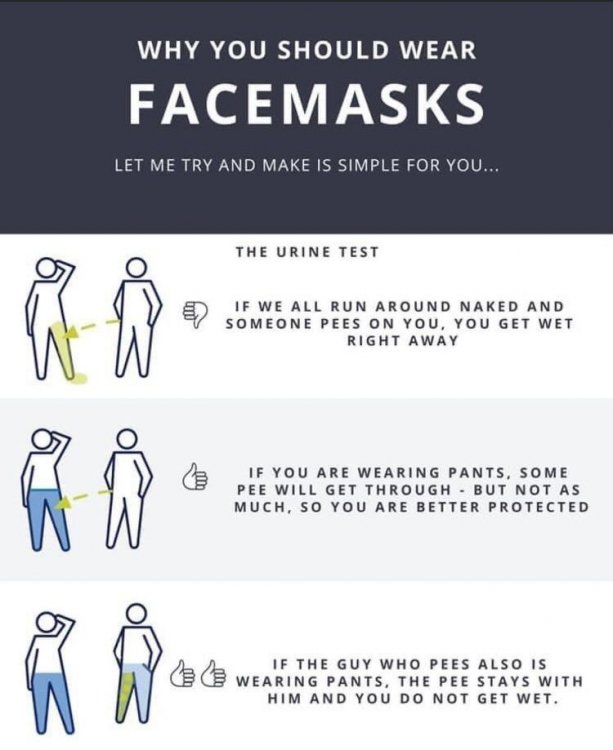
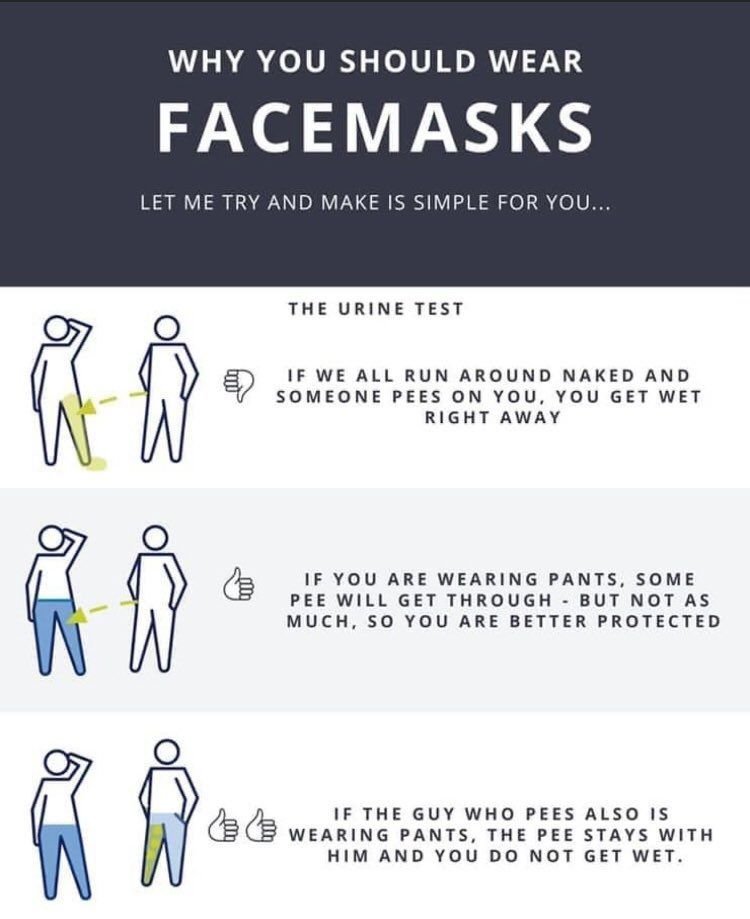
Even with all the vehicles skipping spaces can you imagine how icky the lot would smell with all the engines running for the AC? Yuk. Nice graphic I found on why people should wear masks. It was only 73F and I went to Costco my homemade mask was very moist after about 45 minutes in the store. Going to need a a big supply to make it through a day at the park in July.
 1 point
 -
1 point
-
If you think Kings Island cannot open without "ensuring nobody with Covid-19 is inside the park", you are terribly out of touch with reality. No business that's already been open this whole time can ensure nobody with Covid-19 is inside. And guess what---more things are about to be open. All kinds of things. Restaurants are opening, movie theaters are allowed to open soon...not a one of them are making sure Covid-19 isn't in the building! For one, it'd be impossible for every business to ensure it. For two, most of America doesn't want to take a test just to watch a movie or have a meal. Or dare I say...stand in line to ride a roller coaster.1 point
-
The fact of the matter is this virus appears to be way less deadly than everyone thought (myself and experts included), yet it continues to be sensationalized. They are fudging death rates by calling it a corona death no matter how you die, as long you test positive. This means if you are positive and die in a car crash it is a corona death. That said, yes precautions should be taken but it sure seems time to allow people to decide for themselves if the risk of going out is worth it. If you have a condition that makes you more susceptible, quarantine yourself and stay safe. Otherwise, I see no justification for the fear mongering and authoritarianism. Life has to go on and the virus has to eventually run its course. We can not wait a year for a vaccine. My two cents, live your life the way you see fit and you will receive no criticism from me, just do not impose your choices on me (outside of common sense precautions).1 point
-
So, according to your logic nobody should ever leave their house again, thereby dying of starvation, infection, heart attacks etc. You can do everything you can do to provide an environment to promote a safer environment, but nothing is 100%! Sent from my Pixel 4 XL using Tapatalk1 point
-
Hand sanitizer and lysol kill 99.9% of germs, not 100% Like mentioned by others, there is no guarantee that things will be 100% safe. The only way the park would ever be 100% safe of disease would be to never open again ever. People can get sick at KI regardless if there's a pandemic or not. Everything comes with a risk, how big of a risk is the debate that'll decide what opens and when.1 point
-
@gforce1994 Again with the fatalism. Nothing in this world is 100% safe. Nothing. Because that means anything comes with a zero percent chance of risk. Even taking a breath involves risk. And providing N95 masks is not the way to go. If they are not fit tested, the mask is absolutely pointless. Sent from my Pixel 4 XL using Tapatalk1 point
-
Back when Cedar Fair seemed like they would be adding Triotech dark rides to most of their parks, I had in the back of my head the thought that Phantom Theator could be re-born as Kings Islands version of on of these rides. It woud be cool to see it again. The characters from the ride are essentially Kings Islands (IP) characters and seem pretty fondly remembered.1 point


.thumb.jpg.7151e82ec80195bbd68677ab7c410841.jpg)














This leaderboard is set to New York/GMT-04:00